
Chad Everett Woods
Inventor · Founder · Technology Architect · Investor · Builder
Chad Everett Woods is an American inventor, technology founder, and entrepreneur building at the intersection of artificial intelligence, robotics, semiconductor architecture, advanced memory, and next-generation computing infrastructure.
He is the founder of 211IQ Inc., a technology company pursuing an ambitious objective: creating an intelligent operating and hardware infrastructure capable of connecting AI with machines, robots, specialized computing systems, and real-world environments.
The next revolution in artificial intelligence will not come from intelligence alone. It will come from fundamentally changing how intelligence moves, remembers, computes, and acts.
That philosophy has driven the development of a growing intellectual-property portfolio spanning AI infrastructure, robotics, compute-in-memory architectures, semiconductor thermal systems, secure machine communication, and hardware/software integration.
Inventing Beyond the Software Layer
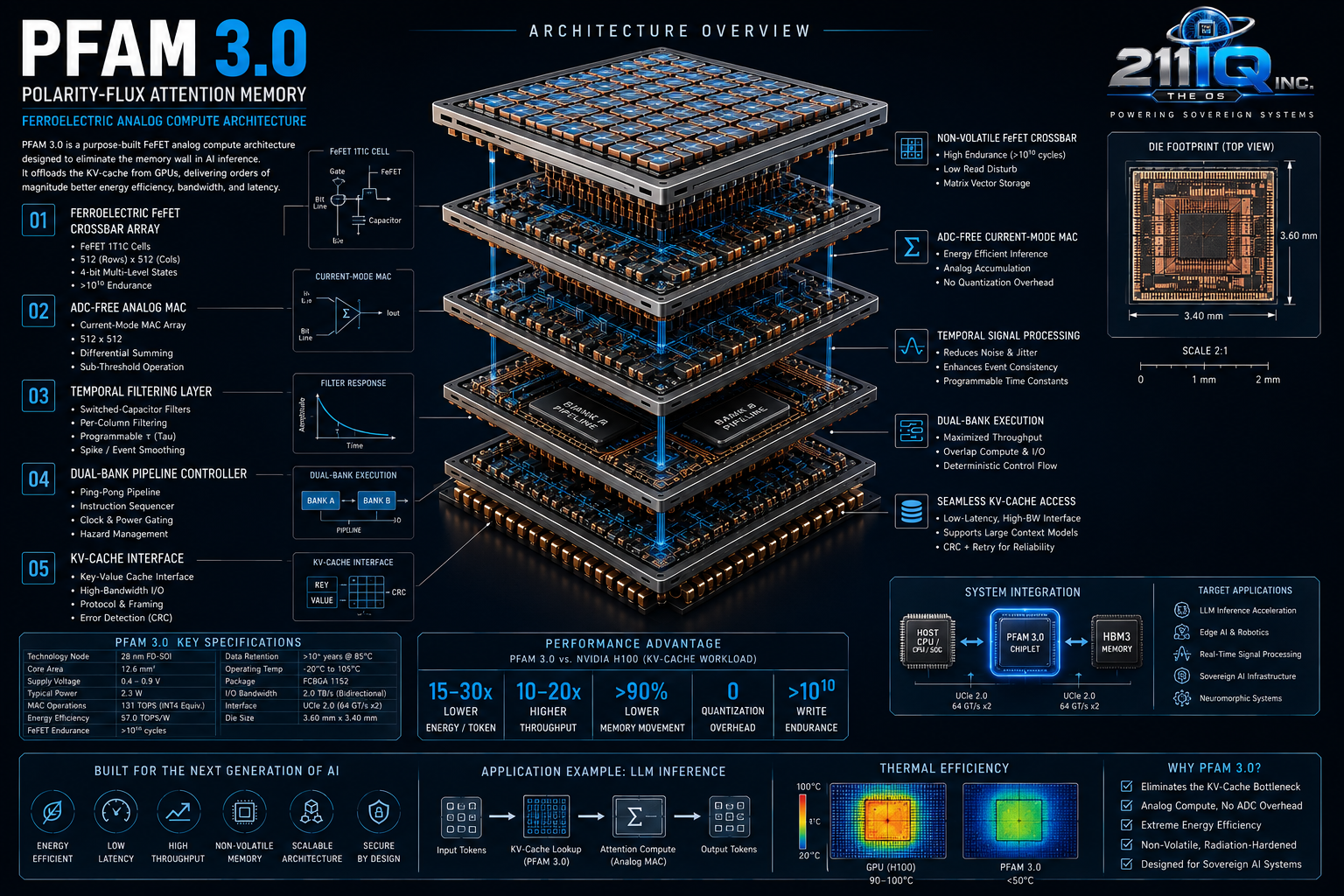
At the center of Woods’ semiconductor work is PFAM™ — Polarity-Flux Attention Memory, a proposed compute-in-memory architecture designed to attack one of modern AI’s fundamental constraints: the enormous cost of repeatedly moving data between memory and processors.
Rather than accepting conventional memory and compute boundaries as permanent, PFAM explores whether portions of transformer attention computation can be moved closer to — or directly into — memory.
The architecture under development incorporates concepts involving FeFET-based computation, transformer attention acceleration, KV-cache operations, chiplet integration, UCIe connectivity, and retrofit approaches for SRAM, DRAM/HBM and GPU-class memory systems.
Woods’ patent work extends beyond PFAM into advanced semiconductor thermal infrastructure, including architectures involving diamond thermal management, dynamic thermal control, heterogeneous semiconductor integration, neuromorphic and advanced-computing applications.
His objective is larger than designing another chip. It is to rethink the infrastructure underneath artificial intelligence.
211IQ: Building an Operating Layer for Intelligent Machines
Through 211IQ Inc., Woods is developing a broader AI and robotics ecosystem intended to allow intelligence to operate across different machines without requiring every robot or device to be engineered around a completely separate intelligence stack.
The 211IQ vision combines software, specialized hardware and secure machine interfaces into a common architecture.
Development concepts include the 211IQ Universal Robot Adapter, intelligent computing nodes, voice interfaces, robotics runtime technology, secure command architectures, proprietary language/compiler technology, and hardware integration designed to bridge AI systems with multiple robotic platforms.
The long-term thesis is straightforward but enormous: AI should not merely answer questions. It should be capable of securely operating the physical world.
An Inventor’s Approach
Woods approaches technology from the perspective of architecture rather than individual products.
Instead of asking how to make an existing system incrementally faster, he repeatedly asks a more fundamental question:
What assumption can be removed entirely?
If moving memory consumes enormous energy, move computation toward the memory. If heat limits computing density, redesign the thermal architecture. If every robot speaks a different hardware language, create an abstraction layer between intelligence and the machine. If today’s computing architecture forces information to travel continuously, explore architectures in which computation travels toward knowledge instead.
This systems-level philosophy connects Woods’ work across semiconductors, AI, robotics and computing infrastructure.
Capital, Ownership & Institution Building
Woods’ ambitions extend beyond invention.
His work includes building corporate and investment structures intended to transform intellectual property and operating businesses into durable institutions.
His ventures include 211IQ Inc., House of Surety SPV Ltd., and the Everett Woods Foundation, alongside intellectual-property structures associated with the MindFuel XL Private Trust.
Through these organizations, Woods is developing a model that connects invention, ownership, commercialization, investment and philanthropy rather than treating them as unrelated pursuits.
His philosophy is that transformative intellectual property should create more than products. It should create institutions capable of surviving their founders.
Building the Next Chapter
Woods’ current work represents a convergence of several disciplines normally pursued independently:
- Artificial intelligence
- Robotics
- Semiconductors
- Advanced memory
- Thermal engineering
- Secure machine communication
- Intellectual property
- Capital formation
The common thread is infrastructure.
Woods is not attempting to predict exactly what the intelligent world will look like decades from now. He is working to build pieces of the infrastructure that could make that world possible.
From machines capable of interacting with general-purpose intelligence, to memory architectures designed around AI workloads, to new approaches for controlling the heat and data movement that constrain modern computing, his work is centered on problems that become increasingly important as artificial intelligence moves from software into the physical world.
And despite the scale of the vision, Woods’ story remains in its building phase.
The prototypes, validation, engineering, manufacturing and commercialization ahead will determine which of these ideas ultimately become enduring technologies.
That is precisely where Woods chooses to operate: at the point where an idea must become architecture, architecture must become engineering, and engineering must ultimately prove itself in the real world.
Patent Portfolio — Filed Provisional Applications
Nine U.S. provisional utility applications filed with the United States Patent and Trademark Office under 35 U.S.C. 111(b), naming Chad Everett Woods as inventor:
App. No. 64/090,349Filed June 14, 2026
211IQ DX PFAM Cache Killer: Diamond-Integrated Ferroelectric Compute-in-Memory Chipset for Transformer Attention Acceleration
App. No. 64/090,324Filed June 14, 2026
Method and Apparatus for Retrofitting Existing Volatile and Commodity Memory Arrays as Analog Attention Accelerators for Transformer Neural Networks
App. No. 64/088,647Filed June 12, 2026
Thermal Infrastructure Platform for Semiconductor Systems Using Direct Low Temperature Covalent Diamond Integration
App. No. 64/086,813Filed June 10, 2026
Polarity Flux Attention Memory (PFAM) Compute-in-Memory Using Transient Polarization Switching Current for Transformer Attention
App. No. 64/085,119Filed June 8, 2026
System and Method for a Hybrid Tokenized Ecosystem with Atomic NFT Instrument Minting, Dual-Instrument Final Expense Benefit, Criminal Surety Bond Home Access, and Tradeable Debt Instrument Non-Fungible Tokens (211IQ Token Ecosystem)
App. No. 64/077,879Filed May 29, 2026
Domain-Scoped Compiled Language System with Post-Quantum Encrypted Hardware Packet Output and Robot Sensor Runtime
App. No. 64/073,189Filed May 23, 2026
211IQ NODE MINI Autonomous Universal Studio Control Appliance with Edge AI, Multi-Protocol Hardware Orchestration, and Voice-Controlled Scene Automation
App. No. 64/073,175Filed May 23, 2026
211IQ NODE MINI Autonomous Universal Studio Control Appliance with Edge AI, Multi-Protocol Hardware Orchestration, and Voice-Controlled Scene Automation (companion filing)
App. No. 64/072,232Filed May 22, 2026
211IQ Native Language System and Secure AI Execution Architecture
Provisional applications establish a priority date and are pending; they are not issued patents. Application 64/073,175 names a co-inventor.
Technical Architecture — PFAM 3.0
The centerpiece of the portfolio is PFAM™ — Polarity-Flux Attention Memory, an in-memory computing architecture that computes transformer self-attention inside a ferroelectric memory array rather than shuttling key-value cache data between memory and compute dies. At long context lengths, attention and KV-cache movement dominate large language model inference latency on conventional GPU architectures; PFAM targets that bottleneck directly.
PFAM 3.0 is the current and strongest generation of the architecture: a ferroelectric analog compute design built on state-dependent transient response, calibrated temporal filtering, and ADC-free in-memory multiply-accumulate. It organizes seven cooperating layers across device, sensing, array, system, thermal, and packaging domains:
1 — Ferroelectric compute array
FeFET and FeCAP cells store multi-level polarization states, with sub-coercive or tailored pulses inducing a state-dependent transient response used directly as the computational primitive.
2 — Temporal filtering & sensing
Gated integration, peak/derivative detection, and lock-in sensing extract the state-dependent transient feature without a conventional analog-to-digital conversion stage.
3 — Differential reference path
A dummy reference cell cancels feedthrough and capacitive coupling, improving signal-to-noise ratio and linearity across the array.
4 — Calibration subsystem
Multi-point reference cells feed a non-linear transfer function that linearizes raw analog output into a calibrated multiply-accumulate result, compensating device-to-device variation and drift.
5 — Pipelined dual-bank architecture
One bank handles write and update while the other performs compute and read, with a scheduler swapping banks to target continuous, bubble-free throughput.
6 — Thermal management
A directly integrated synthetic diamond heat spreader targets low junction temperature to minimize coercive-field drift and improve endurance under sustained analog compute density.
7 — Chiplet connectivity
A UCIe interface over a silicon interposer enables modular scaling into multi-tile PFAM systems.
Summary description only. Claim language, embodiments, process parameters, and measured device data are not published here. PFAM 3.0 supersedes earlier PFAM generations described in the pending provisional and continuation filings above.
Research Status & Validation
Woods’ portfolio spans concepts at multiple stages of maturity — from issued and pending patent filings, to engineering prototypes and architectural models, to early-stage physics and materials research still undergoing independent validation. The technical descriptions here reflect objectives, proposed architectures, and development directions rather than commercially validated products.
As with any deep-technology work, the path from concept to proven product requires engineering, manufacturing, testing, and third-party verification. Woods is open about that distance: the work is in its building phase, and the validation ahead will determine which ideas become enduring technologies.
Chad Everett Woods
Inventor. Founder. Architect. Builder.
Founder, 211IQ Inc.
Inventor, PFAM™ — Polarity-Flux Attention Memory
Founder, House of Surety SPV Ltd.
Founder, Everett Woods Foundation
Building infrastructure for the intelligent age.